
When An Old Medicine List No Longer Matches: A Fictional Example
An older clinic printout can be a useful reference without being a current list. This fictional example shows how to keep the date, the question, and the uncertain detail together.
Illustrative Scenario — Not A Glassman Client Case
Nora and the events below are fictional. This educational example is not a testimonial, a real claim, or a benefits outcome.
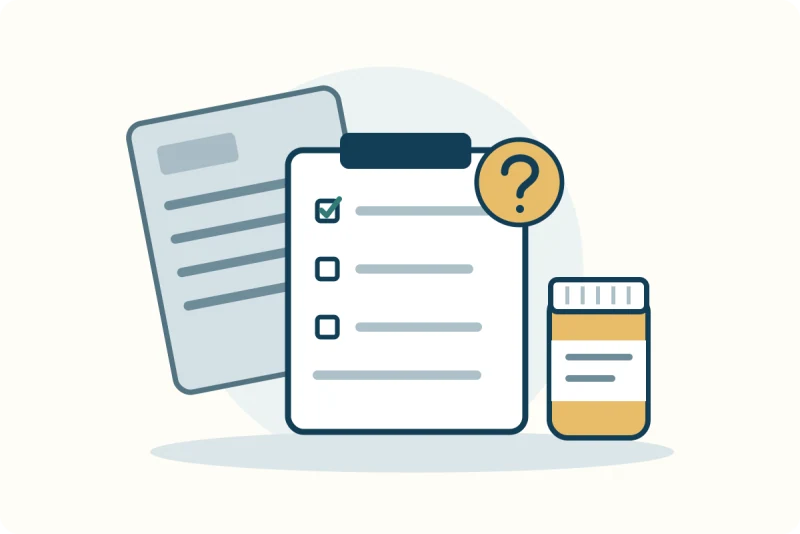 AI-assisted editorial illustration.
Keep The Date With The Question
Compare the references you have and flag the details that still need clarification.
Use The Checking PromptsThe Old List On The Table
In this fictional scene, Nora is organizing information for an Adult Disability Report. She finds a medication list printed after a clinic visit several months ago. It is neat, so she starts copying it.
Then she notices a mismatch. One entry describes a short course of medicine she finished. A medicine she now takes is missing. She also uses a nonprescription medicine occasionally, which she had not thought to include in her notes. The old sheet is useful history, but copying it unchanged would leave her preparation notes out of date.
Nora keeps the old copy with its date. On a separate sheet, she writes what she currently takes and circles the details she needs to confirm. She does not treat the older printout as an instruction to restart a medicine.
Read The Question On The Actual Report
Section 7 of SSA’s Adult Disability Report, SSA-3368-BK (PDF), asks about current prescription and nonprescription medicines. It requests each medicine’s name, the prescribing doctor if known, and the reason for taking it if known. It points readers to medicine containers for information and Section 11 when more space is needed.
Nora compares those questions with her notes instead of assuming every item on the old sheet belongs in the current-medicines section. Other forms can ask different questions; this example concerns Section 7 of this report.
One doctor’s name is still unclear. Nora marks that uncertainty rather than filling in a name from memory. SSA’s instructions for completing the paper report say to record that the information is not known when the person cannot provide it.
Turn Each Difference Into A Question
Nora prepares three short questions for a conversation with her health care team: Which entry is from the finished course? What is the exact name of the newer medicine? Who prescribed the medicine whose label she cannot read clearly? She keeps the questions beside the records that prompted them.
The FDA recommends updating a medication list when medicines change and including prescription medicines, nonprescription drugs, vitamins, and supplements. That broader health list can support a discussion with a doctor or pharmacist; it is not a substitute for following the questions on the SSA report.
Do not start, stop, or change a medicine to make a list agree. Ask your health care professional about treatment instructions. The FDA’s medicine-safety guide recommends asking a doctor, nurse, or pharmacist about medicines and talking to a provider before stopping them.
A Clearer Preparation Note
Nora’s original note was simply “copy clinic list.” Her revised note separates the source from the unresolved question:
Older clinic printout: keep as a dated reference. Current medicine list: check against the information I use now. One prescriber’s name still needs clarification. Ask about that entry instead of guessing.
This is an invented organizational example, not wording to copy into an application. Nora has improved the way she tracks a question. The story makes no claim about eligibility, what SSA will decide, or whether a particular medicine supports a disability claim.
Your List-Checking Prompts
Use these optional prompts on paper. They help track differences; they are not a medication schedule, a complete health record, or an SSA form. Keep your answers privately with your records, not in this website’s chat.
- Record I Am Comparing And Its Date: ____________________
- Entry Or Missing Detail To Check: ____________________
- Question And Person To Ask: ____________________
- Answer, Source, And Date Checked: ____________________
For a different organizing task, use our medical-provider list guide. It helps track treatment locations and contact details rather than reconcile medicines.
Sources And Scope
Sources checked October 18, 2026: SSA-3368-BK, Section 7 (PDF); SSA Paper-Report Instructions, Section 7; FDA Medication-List Guide; FDA Medicine-Safety Guide.
This AI-assisted fictional example was checked against the linked sources. It has not been reviewed by an attorney or clinician. The scenario and worksheet are original educational aids. Glassman Disability is not SSA. This page does not provide treatment advice or predict a benefits decision.
Use the printable prompts privately. This page does not collect your notes or assess eligibility. Checklist selections are not saved by this page.