
When A Friend Sees Only Part Of The Day: A Fictional Example
A friend can know someone well and still see only a small part of their week. This fictional example shows how to describe that limited view when completing a third-party function report.
Nora and Leah are fictional. This example describes an observer's paperwork, not a real client, testimonial, medical finding or benefits outcome.
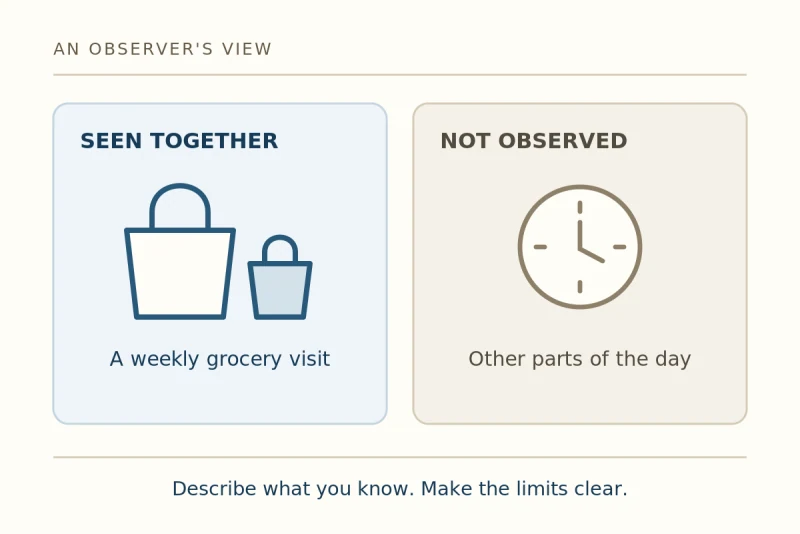 AI-assisted editorial illustration.
Observed And Unknown
Separate what you actually see from the parts of a routine you do not know.
Read The Observer NoteA Friend With A Limited View
In this fictional scene, Nora receives a request to complete an Adult Third-Party Function Report about her friend Leah. They have known each other for six years. For the past six months, Nora has visited on most Saturdays to help bring groceries into Leah's apartment. A visit usually lasts about half an hour.
Nora can describe those visits. She cannot describe Leah's entire day. She is not there at bedtime, during personal care or on most weekdays. Her first planning note, “I help Leah at home,” leaves both her actual help and the limits of her knowledge unclear.
This is a different task from typing an applicant's answers for them. Our form-helper example describes that separate situation. Here, Nora is being asked for information she knows as another person.
Start With Your Own Knowledge
The official SSA-3380 instructions say to describe what you know about the person's activities and abilities, and not to ask that person to give you the answers. They also say not to leave answers blank: use the appropriate response when you do not know, when there is none, or when a question does not apply.
Question 6 asks how long you have known the person, how much time you spend together and what you do together. In Nora's situation, that is useful context for the rest of the report. Knowing a friend for years does not mean observing every part of their current routine.
Nora does not ask Leah to supply a full day's answers to fill the gaps. She describes her own contact and leaves uncertainty visible. She also avoids turning something she has not observed into a claim that Leah cannot do it.
A More Specific Observation Note
Nora separates what happens during her visits from the parts of the week she does not see. Her private planning note might read:
Time Together: I usually visit on Saturdays for about half an hour to help with groceries.
What I See And Do: On these visits, I carry two grocery bags from the car. Leah carries a small bag. She sits at the kitchen table while I put the other groceries away.
What I Do Not Know: I am not there for the rest of her day. I do not know her usual bedtime routine or how she manages personal care.
These are invented circumstances, not wording to copy into someone else's report. The point is to identify the setting, the activity and the help actually observed. Nora does not turn a small bag into a lifting limit, guess its weight or conclude how long Leah could work.
The form's opening instructions ask the reporter to identify help from others when an activity involves that help. Its shopping section asks about shopping methods, purchases, frequency and time. A short visit may provide information about some of those questions without answering all of them.
Check The Actual Report
The note above is an original organizing aid, not an additional SSA form or a completed SSA-3380. Use the requested report and its instructions. If an answer needs more room, the instructions direct you to the Remarks section and ask you to identify the question number. Complete the actual reporter details at the end; the email field is optional.
Activity I Can Describe: ____________________
When And How I Observed It: ____________________
What I Do Not Know: ____________________
If you need help, SSA-3380 says to complete as much as you can and call the number on the accompanying letter or contact the person who requested the form. Follow the actual request's return instructions. Printing this page does not send information to SSA.
The Limited Takeaway
Nora's revised note gives a clearer account of her visits and avoids pretending she sees the whole day. The example ends there. It contains no claim decision and does not predict whether Leah qualifies for benefits.
SSA's evidence regulation distinguishes statements from nonmedical sources from medical opinions and other medical evidence. An observer's report is not a medical assessment or an eligibility decision. For broader context, see medical evidence for disability benefits.
Sources And Review Notes
Sources checked October 25, 2026: SSA-3380, Adult Third-Party Function Report, instructions and questions 6 and 19, plus the final Remarks and completer fields; and 20 CFR 404.1513, Categories Of Evidence.
Prepared with AI assistance and source checking. The people, scene and planning prompts are original educational fiction. No attorney review is claimed. General information, not individual legal or medical advice; Glassman Disability is not SSA. Keep completed notes private and do not enter another person's sensitive information in this website's chat.
Use the printable prompts privately. This page does not collect your notes or assess eligibility. Checklist selections are not saved by this page.